
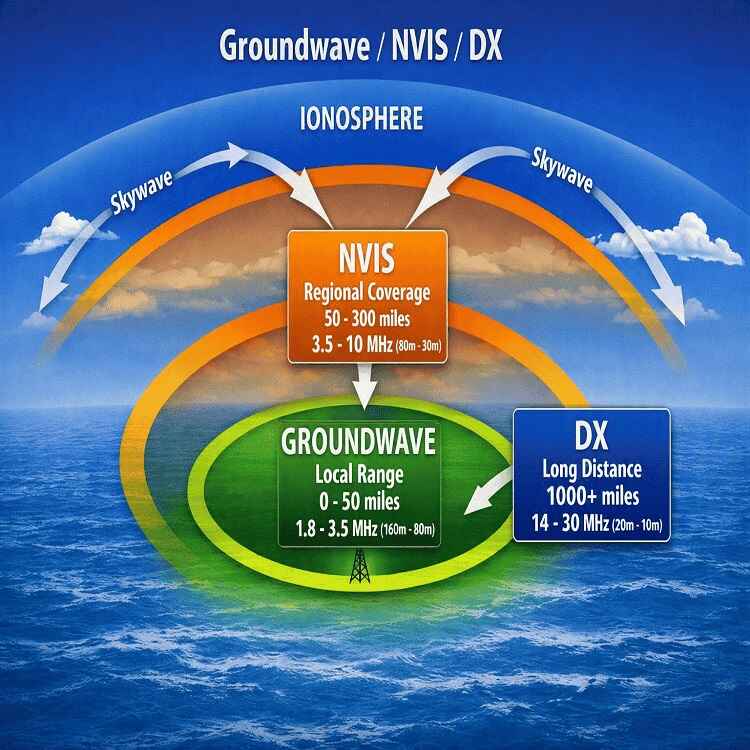
High Frequency (HF) radio operators often face a challenge: how to cover local, regional, and long-distance communications with a single antenna system. Alpha Antenna’s designs — such as the HexTenna, ProMaster, and HD-FMJ series — are engineered to address all three major HF propagation modes: Groundwave, Near Vertical Incidence Skywave (NVIS), and DX.
Understanding the three modes
Groundwave
Groundwave propagation follows the Earth’s surface, making it ideal for short-range, reliable communication — often within 0–50 miles, depending on frequency and terrain. It’s especially useful for emergency communications and local nets where line-of-sight VHF/UHF isn’t practical.
NVIS (Near Vertical Incidence Skywave)
NVIS uses high-angle HF radiation to bounce signals almost straight up into the ionosphere, returning them to Earth within a 50–300 mile radius. This is invaluable for regional coverage in mountainous or obstructed terrain, where VHF/UHF signals can’t penetrate and low-angle DX signals skip over the area.
DX (Long-Distance)
DX relies on low-angle HF radiation to refract off the ionosphere and travel thousands of miles. This is the mode most associated with international contacts and contesting.
How Alpha Antenna Designs Support All Three
Alpha Antenna’s high-performance HexTenna, ProMaster, and HD-FMJ systems are engineered to be multi-mode capable:
- Groundwave: The vertical radiator element in these antennas supports low-loss surface wave propagation, especially effective on lower HF bands.
- NVIS: Optional or integrated horizontal elements (mounted 5–7 feet above ground) enhance high-angle radiation, boosting regional coverage.
- DX: The vertical component and tuned counterpoise system provide efficient low-angle radiation for long-haul contacts.
The Enhanced NVIS Option for the HD-FMJ and ProMaster adds four horizontal elements that significantly improve high-angle performance without sacrificing DX capability.
The Survivor Tripod Option adds even more capabilities, because it can be deployed at height to enhance Groundwave or DX or laid flat to further enhance NVIS.
Deployment Tips for Optimal Performance
- For Groundwave: Keep the vertical radiator clear of nearby obstructions and ensure a good ground or counterpoise system.
- For NVIS: Mount horizontal elements low (5–7 feet) and use frequencies in the 3.5–10 MHz range during the day for best results.
- For DX: Position the antenna in an open area, use higher HF bands (14 MHz–30 MHz) during daylight, and lower bands (7 MHz and below) at night.
Why these matters
In emergency communications (EmComm), conditions can change rapidly. Having a single antenna that can handle local, regional, and global communication without reconfiguration is a major advantage. Alpha Antenna’s designs allow operators to adapt to changing propagation simply by changing frequency — not hardware.
Conclusion
Whether you’re checking in with a local net, coordinating disaster relief across a state, or chasing rare DX stations, Alpha Antenna’s HexTenna, ProMaster, and HD-FMJ systems offer a versatile, field-proven solution. By understanding and leveraging Groundwave, NVIS, and DX propagation, operators can maximize their reach and reliability with a single, well-designed antenna.
Just keep in mind it’s the ionosphere that makes most of the difference. All we do is send the signal in the correct direction.